


 PDF Version Demo
Walking into the Financial-Accounting-Reporting exam without ever practicing under timed conditions is a risk you do not need to take. The Dumpkiller test engines simulate the real exam environment, letting you rehearse with 161 Admission Test Certified Public Accountant (Financial Accounting & Reporting) practice questions until the format feels second nature.
Admission Test Financial-Accounting-Reporting Exam Overview:
| Certification Vendor: | AICPA / NASBA |
|---|---|
| Exam Name: | Financial Accounting and Reporting (FAR) |
| Exam Number: | FAR |
| Exam Price: | $238.15 USD (varies by jurisdiction) |
| Exam Duration: | 240 minutes |
| Passing Score: | 75 (scaled score) |
| Real Exam Qty: | 57 (50 MCQs + 7 Task-Based Simulations) |
| Exam Format: | Task-Based Simulations (TBS), Multiple Choice Questions (MCQs) |
| Available Languages: | English |
| Related Certifications: | AUD REG BAR / ISC / TCP (CPA Evolution disciplines) |
| Certificate Validity Period: | 18 months (to pass all CPA exam sections after first pass) |
| Recommended Training: | Wiley CPA Exam Review Becker CPA Review Gleim CPA Review |
| Exam Registration: | AICPA CPA Exam Information Prometric CPA Exam Scheduling NASBA CPA Candidate Portal |
| Sample Questions: | DOWNLOAD DEMO |
| Exam Way: | Computer-based testing at authorized Prometric test centers |
| Pre Condition: | No formal prerequisite for exam entry, but candidates must meet state-specific CPA licensure education requirements (typically 120–150 semester hours). |
| Official Syllabus URL: | https://www.aicpa-cima.com/cpa-exam |
Admission Test Financial-Accounting-Reporting Exam Syllabus Topics:
| Section | Objectives |
|---|---|
| Governmental and Not-for-Profit Accounting | - Governmental fund accounting - Not-for-profit financial reporting |
| Conceptual Framework and Financial Reporting | - Financial statement presentation - Disclosure requirements - FASB conceptual framework |
| Equity, Investments, and Business Combinations | - Bonds and debt instruments - Stockholders' equity - Business combinations and consolidations |
| Assets and Liabilities Accounting | - Leases (ASC 842) - Fixed assets and intangible assets - Cash, receivables, and inventory - Liabilities and contingencies |
| Financial Statements and Transactions | - Revenue recognition (ASC 606) - Income statement and comprehensive income - Balance sheet and statement of cash flows |
| Specialized Accounting Topics | - Foreign currency transactions - Accounting changes and error corrections - Pensions and post-employment benefits |
Admission Test Certified Public Accountant (Financial Accounting & Reporting): Common Questions From Candidates
What is the Admission Test Certified Public Accountant (Financial Accounting & Reporting) certification exam?
The Admission Test Certified Public Accountant (Financial Accounting & Reporting) exam (code: Financial-Accounting-Reporting) is the official Admission Test exam that leads to the Certified Public Accountant (CPA) certification. It sits at the Professional level of the Admission Test certification track. It is also connected with related credentials such as AUD, REG, BAR / ISC / TCP (CPA Evolution disciplines). Passing it proves to employers that your skills have been validated by Admission Test itself, which is why the Financial-Accounting-Reporting credential keeps showing up in job postings.
How many questions are in the Financial-Accounting-Reporting exam, and how long does it take?
The Admission Test Certified Public Accountant (Financial Accounting & Reporting) exam gives you 240 minutes to work through 57 (50 MCQs + 7 Task-Based Simulations). Pacing matters more than most candidates expect, so before exam day, run at least one full timed session in the Dumpkiller test engine to learn how long you can afford per question. If an item stalls you, flag it and move on — coming back later beats burning five minutes on a single question.
What score do I need to pass the Financial-Accounting-Reporting exam, and how much does it cost?
The passing score for the Admission Test Certified Public Accountant (Financial Accounting & Reporting) exam is 75 (scaled score), and the official registration fee is $238.15 USD (varies by jurisdiction). Remember that a failed attempt means paying that fee in full again, so a timed self-assessment with Dumpkiller practice questions about a week before your exam date is a cheap way to confirm you are scoring comfortably above 75 (scaled score).
Are there any prerequisites for the Financial-Accounting-Reporting exam?
According to Admission Test, the following applies: No formal prerequisite for exam entry, but candidates must meet state-specific CPA licensure education requirements (typically 120–150 semester hours).. Certification policies do change from time to time, so confirm the latest requirements on the official exam page at https://www.aicpa-cima.com/cpa-exam before you register.
How do I register for the Financial-Accounting-Reporting exam?
You can book your Admission Test Certified Public Accountant (Financial Accounting & Reporting) exam through the official channels below:
Depending on availability in your region, the exam is delivered as Computer-based testing at authorized Prometric test centers.
What official training does Admission Test recommend for the Financial-Accounting-Reporting exam?
Admission Test lists the following training options for Admission Test Certified Public Accountant (Financial Accounting & Reporting) candidates:
Official courses build a solid foundation, and pairing them with the 161 practice questions from Dumpkiller shows you how ready you really are before you spend money on the exam itself.
Can I try the Financial-Accounting-Reporting practice questions before buying?
Yes. Dumpkiller offers a free Financial-Accounting-Reporting PDF demo so you can review the question style, difficulty, and explanations before committing to anything. After purchase, your Admission Test Certified Public Accountant (Financial Accounting & Reporting) material includes 365 days of free updates, and if your product expires after that, you can extend the update service at a 50% discount from your member zone.
What happens if I do not pass the Financial-Accounting-Reporting exam, and how is my order delivered?
If you take the corresponding Financial-Accounting-Reporting exam within 60 days of your purchase and do not pass, you can apply for a full refund under our 100% Money Back Guarantee, subject to a few conditions: the failed exam must be the one matching your purchase; sitting the exam within 3 days of purchase does not qualify, since that leaves too little preparation time; downloading the material without actually taking the exam does not qualify; free materials and expired orders are excluded; and the candidate name must match the payer name. To apply, send a scanned copy of your enrollment slip together with your official Score Report (PDF) within 2 days after the exam, and claims are processed within 7 days. If you would rather not take a refund, you can exchange your purchase for two free products of equal value while keeping the update service on the product you originally bought. As for delivery, everything is an instant download: your products are sent to your email within one minute of payment — contact customer service if nothing arrives within 2 hours — and there is no limit on the number of computers you can install the software on.
What topics are covered in the Financial-Accounting-Reporting exam?
The official Admission Test Certified Public Accountant (Financial Accounting & Reporting) syllabus is organized into 6 main domains. The first three are Governmental and Not-for-Profit Accounting, Assets and Liabilities Accounting, and Equity, Investments, and Business Combinations. For the full domain-by-domain breakdown, see the complete Exam Topics outline above.
Admission Test Certified Public Accountant (Financial Accounting & Reporting) Sample Questions:
Question #1
In which of the following situations should a company report a prior-period adjustment?
A. The correction of a mathematical error in the calculation of prior years' depreciation.
B. A change in the estimated useful lives of fixed assets purchased in prior years.
C. A switch from the straight-line to double-declining balance method of depreciation.
D. The scrapping of an asset prior to the end of its expected useful life.
Question #2
Grum Corp., a publicly-owned corporation, is subject to the requirements for segment reporting. In its income statement for the year ended December 31, 1991, Grum reported revenues of $50,000,000, operating expenses of $47,000,000, and net income of $3,000,000. Operating expenses include payroll costs of $ 15,000,000. Grum's combined identifiable assets of all industry segments at December 31, 1991, were $40,000,000.
Cott Co.'s four business segments have revenues and identifiable assets expressed as percentages of Cott's total revenues and total assets as follows: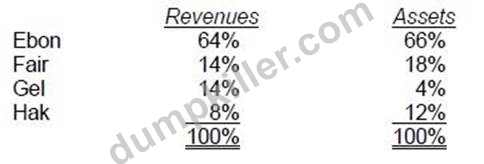
Which of these business segments are deemed to be reportable segments?
A. Ebon and Fair only.
B. Ebon only.
C. Ebon, Fair, and Gel only.
D. Ebon, Fair, Gel, and Hak.
Question #3
On January 2, 1991, Air, Inc. agreed to pay its former president $300,000 under a deferred compensation arrangement. Air should have recorded this expense in 1990 but did not do so. Air's reported income tax expense would have been $70,000 lower in 1990 had it properly accrued this deferred compensation in its December 31,1991, financial statements, Air should adjust the beginning balance of its retained earnings by a:
A. $370,000 debit.
B. $230,000 debit.
C. $300,000 credit.
D. $230,000 credit.
Question #4
Which of the following types of entities are required to report on business segments?
A. Publicly-traded enterprises.
B. Not-for-profit enterprises.
C. Nonpublic business enterprises.
D. Joint ventures.
Question #5
Hyde Corp. has three manufacturing divisions, each of which has been determined to be a reportable segment. In 1989, Clay division had sales of $3,000,000, which was 25% of Hyde's total sales, and had operating costs of $1,900,000, as reported to the CFO. In 1989, Hyde incurred operating costs of $500,000 that were not directly traceable to any of the divisions. In addition, Hyde incurred corporate interest expense of $300,000 in 1989. In reporting segment information, what amount should be shown as Clay's operating profit for 1989?
A. $900,000
B. $975,000
C. $875,000
D. $1,100,000
Solutions:
| Question #1 Answer: A | Question #2 Answer: D | Question #3 Answer: B | Question #4 Answer: C | Question #5 Answer: D |
 1117 Customer Reviews


 Quality and ValueDumpKiller Practice Exams are written to the highest standards of technical accuracy, using only certified subject matter experts and published authors for development - no all study materials.
 Tested and ApprovedWe are committed to the process of vendor and third party approvals. We believe professionals and executives alike deserve the confidence of quality coverage these authorizations provide.
 Easy to PassIf you prepare for the exams using our DumpKiller testing engine, It is easy to succeed for all certifications in the first attempt. You don't have to deal with all dumps or any free torrent / rapidshare all stuff.
 Try Before BuyDumpKiller offers free demo of each product. You can check out the interface, question quality and usability of our practice exams before you decide to buy.